
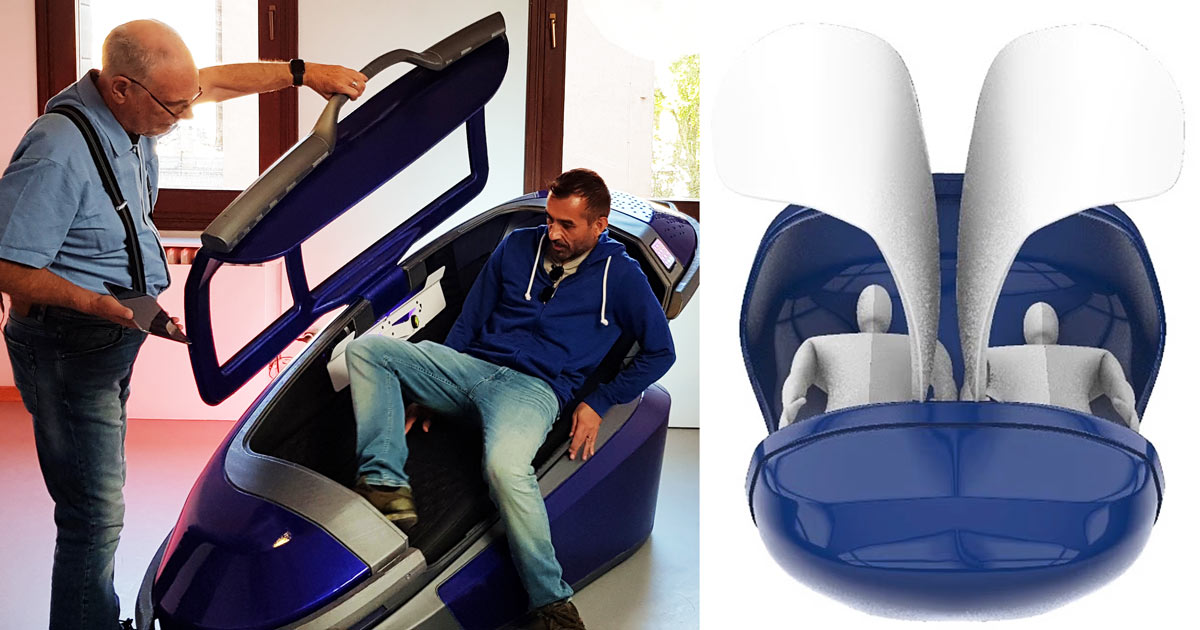
A chilling new “suicide pod” has been unveiled that seeks to streamline the euthanasia process by gassing two people to death at once, all while being powered by artificial intelligence (AI) automation to eliminate human safeguards.
The disturbing new AI-powered “suicide pod” is being pushed forward by a radical euthanasia activist, accelerating what critics warn is a globalist effort to normalize mechanized death under the guise of “choice.”
The new device is known as the “Double Dutch Sarco.”
It’s an upgraded version of the Sarco pod, a nitrogen-gassing capsule linked to the controversial death of a woman in Switzerland in September 2024.
The woman, who became the first human to experience her last moments in a futuristic killing device, lost consciousness within a few minutes after climbing into the device.
When Swiss police arrived on the scene in a verdant forest in Switzerland’s Schaffhausen region, the 64-year-old woman was found dead inside the machine.
However, authorities discovered that she had been strangled to death.
Police seized the pod and arrested the only person present during the death, the late Dr. Florian Willet, co-president of the assisted suicide organisation the Last Resort.
They also arrested his lawyers and a photographer who documented the woman’s arrival.
That death marked the first and only confirmed human fatality involving the Sarco pod.
Swiss police launched an investigation that has still not concluded.
Now, despite ongoing legal uncertainty and the death of his Swiss associate following detention, Sarco inventor Philip Nitschke says he is preparing a new generation of killing machines.
This time, the device is augmented with artificial intelligence and explicitly designed for joint death.
From One Pod to Two Bodies
According to Nitschke, the Double Dutch Sarco pod is large enough to hold two people in the same compartment and requires both users to press activation buttons simultaneously.
“If they both want to die, they have to die together,” he said.
The pod works by flooding the chamber with nitrogen, depriving occupants of oxygen until they lose consciousness and die.
However, the most alarming escalation is not the size of the pod, but the removal of human oversight entirely.
AI Replaces Doctors in Determining Who Gets to Die
Under the new system, users will no longer undergo a psychiatric evaluation to determine mental capacity.
Instead, AI software will decide.
Future users must complete an online “mental capacity test” conducted by an AI avatar.
If the algorithm approves them, the system unlocks the pod for 24 hours, during which they may enter and activate it.
No doctors, in-person evaluations, or human safeguards.
Nitschke confirmed that once AI approval is granted, the device remains operational until the window expires, after which users must submit to another AI assessment.
Switzerland’s permissive assisted-suicide framework, which does not require terminal illness, makes it the only country where the device could legally debut, according to Nitschke.
Critics Warn of “Personalized Gas Chambers”
Opponents have not minced words.
Alistair Thompson of the anti-euthanasia group Care Not Killing previously described the Sarco as a “personalized gas chamber.”
Even some individuals interested in assisted suicide told Nitschke they were disturbed by the isolation of dying alone in a capsule, prompting him to design a system where couples can be gassed together instead.
“What about when people want to die together?” he said.
A Pattern of Escalation, Not Restraint
The rollout comes amid unresolved legal fallout from the original Sarco death and the passing of Dr. Florian Willet, a Swiss associate of Nitschke who was detained for 70 days following the 2024 death.
Willet was later euthanized after suffering severe psychological distress, according to Nitschke, who blamed Swiss authorities for what he described as an unjustified crackdown.
Despite this, Nitschke has doubled down, developing not only the Double Dutch pod but also other DIY euthanasia devices, including a pressure-based neck collar and a proposed implantable “kill switch” for dementia patients.
Each new invention moves further away from medicine and closer to automation, permanence, and mass accessibility.
Death as a Product, Not a Tragedy
Nitschke openly promotes these devices as offering “control,” “peace,” and “efficiency,” arguing that elderly people live with less anxiety once they know they have a guaranteed method of death stored away.
What critics see instead is the industrialization of suicide, driven by ideology, shielded by technology, and increasingly divorced from human judgment or moral restraint.
With AI now positioned as the gatekeeper of life and death, the Sarco project marks a chilling milestone, not in compassion, but in the normalization of algorithm-approved extermination.
And if this is what passes for “choice,” the question is no longer whether society is being conditioned to accept mechanized death, but how far the architects of this system intend to take it next.
READ MORE – Canadian Religious Hospitals May Be Forced to Begin Euthanizing Patients

Our comment section is restricted to members of the Slay News community only.
To join, create a free account HERE.
If you are already a member, log in HERE.