
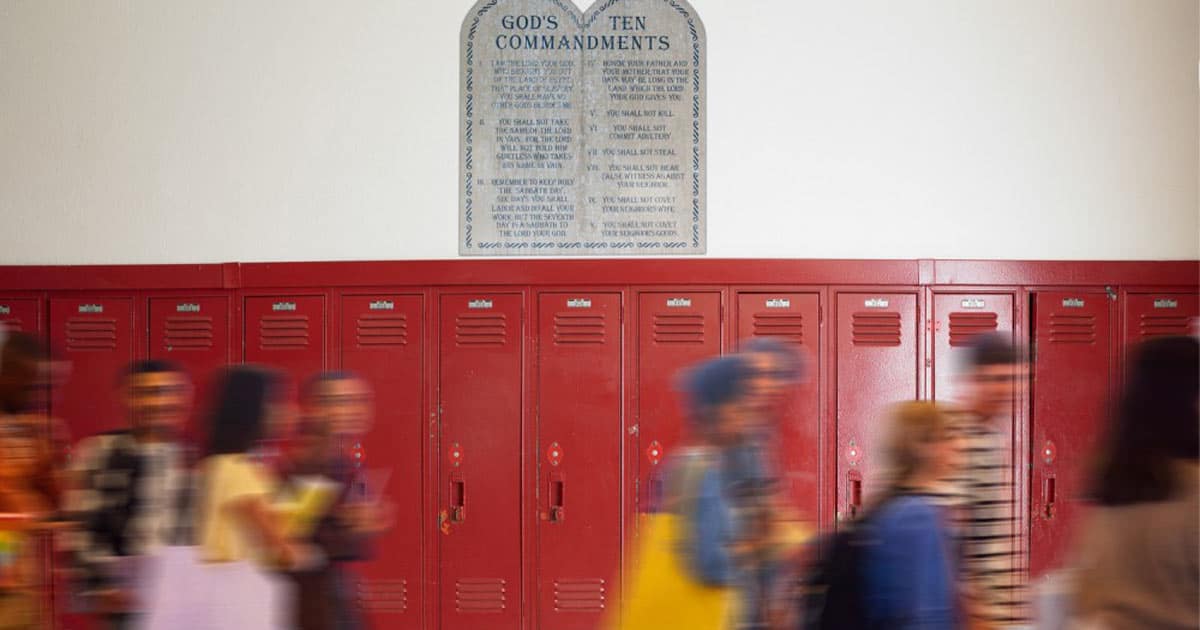
A federal appeals court has sided with Louisiana, allowing the state to move forward, for now, with enforcement of a law requiring the display of the Ten Commandments in public school classrooms.
The 5th U.S. Circuit Court of Appeals ruled that a lower court’s injunction blocking the law was premature.
The appeals court found that opponents had not yet established a sufficiently developed factual record to justify stopping the measure before implementation.
According to the ruling, the Ten Commandments possess both religious and historical significance, and that “dual character forecloses any categorical rule against their display on public property.”
The court wrote:
“The parents (and the principal dissent) seek to sidestep this difficulty by framing the case as an attack on H.B. 71’s minimum requirements alone.
“But an unripe challenge does not become ripe merely because a party asserts that the challenged action would be unlawful on any conceivable set of facts.
“The Supreme Court has squarely rejected that approach.”
The panel indicated that further legal challenges could arise once the law is actually implemented and a “concrete factual record” exists.
State Officials Defend the Law
Louisiana Attorney General Liz Murrill welcomed the decision.
“Don’t kill or steal shouldn’t be controversial,” Murrill said.
“My office has issued clear guidance to our public schools on how to comply with the law, and we have created multiple examples of posters demonstrating how it can be applied constitutionally.
“Louisiana public schools should follow the law.”
The legislation, signed in 2024 by Gov. Jeff Landry, requires public K–12 schools and state-funded colleges and universities to display posters or framed versions of the Ten Commandments.
Supporters argue the measure recognizes the foundational role the Decalogue has played in shaping Western legal tradition and American constitutional principles.
Civil Liberties Groups Push Back
The American Civil Liberties Union and other groups opposing the law criticized the ruling.
“Today’s ruling is extremely disappointing and would unnecessarily force Louisiana’s public school families into a game of constitutional whack-a-mole in every school district. Longstanding judicial precedent makes clear that our clients need not submit to the very harms they are seeking to prevent before taking legal action to protect their rights.”
Opponents contend the law violates the Establishment Clause of the First Amendment, which states that “Congress shall make no law respecting an establishment of religion.”
A similar Kentucky statute was struck down by the U.S. Supreme Court decades ago for lacking a secular purpose.
Changing Legal Landscape
Supporters of Louisiana’s law argue that the Supreme Court’s Establishment Clause jurisprudence has shifted in recent years.
They cite Kennedy v. Bremerton School District (2022), in which the Court emphasized “history and tradition” when evaluating religion-related disputes.
Courts have also previously struck down certain courthouse displays of the Ten Commandments while upholding monuments placed in broader historical contexts, including on Texas state grounds.
Legal observers suggest the outcome of future challenges could hinge on how the displays are implemented, including whether they are presented alongside other historical documents, their size and placement, and whether they appear devotional or educational in nature.
Judicial and Legal Support
Circuit Judge James Ho, in a concurring opinion, wrote that passive displays of the Ten Commandments are not coercive and therefore do not violate the Establishment Clause.
“Our Nation’s Founders didn’t just permit religion in education—they presumed that there would be religion in education,” Judge Ho wrote.
“Indeed, our Founders firmly believed that our Constitution wouldn’t work without a religious people.”
Liberty Counsel, which supports the law, emphasized that the Ten Commandments have long been displayed in public institutions.
Founder Mat Staver stated:
“The Fifth Circuit has rightly ruled that the Ten Commandments can be displayed in public schools.
“Passive Ten Commandments displays do not compel religious exercise, so there is no Establishment Clause violation.
“The Decalogue is a universally recognized symbol of law and has indelibly shaped the Western Legal Tradition and American government.
“There are more than 50 displays of the Ten Commandments inside and outside the United States Supreme Court.
“The Ten Commandments are ubiquitous and their central role in law and government predate the U.S. Constitution, and these displays honor its historical significance to our way of life.”
Likely Supreme Court Showdown
Legal analysts expect the dispute to continue through the courts, potentially reaching the U.S. Supreme Court.
For now, Louisiana may proceed with implementing the law.
It’s a development supporters say affirms the state’s right to acknowledge the historical foundations of American law.
Critics, meanwhile, prepare for the next round of constitutional litigation.
READ MORE – Florida Lawmakers Move to Allow Unlicensed Armed Volunteers to Protect Churches

Our comment section is restricted to members of the Slay News community only.
To join, create a free account HERE.
If you are already a member, log in HERE.