

China is facing a deepening demographic crisis as birth rates collapse and deaths continue to climb, pushing the country into its fourth straight year of population decline.
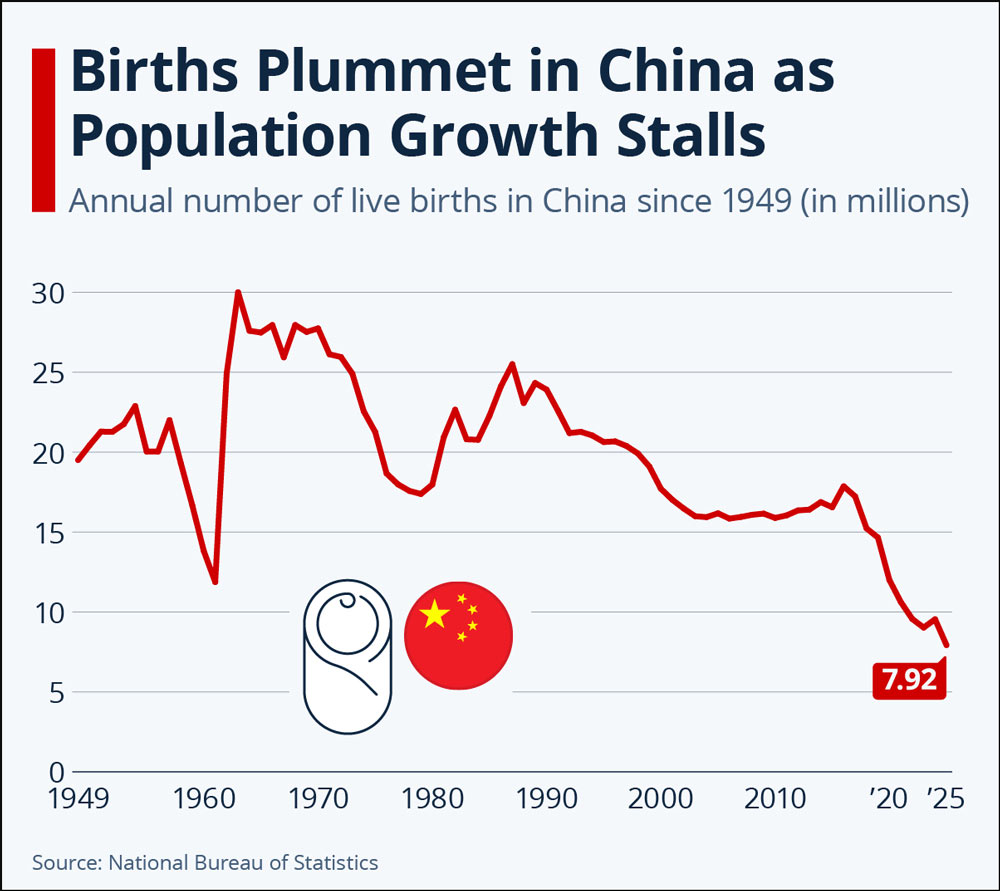
Just 7.9 million babies were born in China in 2025, the lowest number recorded in more than 70 years.
The figure represents a 17 percent drop from the previous year, when births totaled 9.5 million.
According to data from China’s National Bureau of Statistics, the country’s birth rate fell to 5.63 births per 1,000 people in 2025.
The rate is the lowest level since 1949, the year the Chinese Communist Party seized power.
At the same time, China’s death rate rose to 8.04 per 1,000 people, ensuring that the population continued shrinking.
China’s total population now stands at roughly 1.4 billion.
The figure is down for the fourth consecutive year.
The numbers underscore a demographic freefall decades in the making.
China’s fertility rate was already just 1.3 children per woman in 2020.
It has remained well below the 2.1 replacement level required to sustain a stable population since the 1990s.
Despite years of warning signs, Beijing did not abandon its notorious one-child policy until 2016.
The policy was scrapped after fears of overpopulation gave way to panic over an aging society and a collapsing workforce.
Since then, the Chinese government has scrambled to reverse the damage.
Officials have pushed citizens to marry and have children, rolled out financial incentives, and imposed new policies aimed at boosting births.
These measures include payments of 3,600 yuan (about $500) for each child under the age of three.
The government even issued a new tax on contraceptives that took effect on January 1.
The contraceptive tax has sparked criticism, with concerns raised about unintended pregnancies and rising HIV rates.
Even so, the incentives appear to be failing.
Experts cited in the data attribute the fertility collapse to China’s economic and social transformation, including rising education levels, career prioritization, and urbanization.
These are trends that historically correlate with falling birth rates.
Similar demographic declines have been seen across Asia, particularly in Japan and South Korea, where birth rates have plunged to record lows.
In South Korea, deaths now outnumber births, a milestone China is rapidly approaching.
For Beijing, the consequences are stark as China faces a shrinking workforce, a ballooning elderly population, and mounting pressure on social services.
Meanwhile, the country’s long-term economic and geopolitical ambitions remain tied to population growth that no longer exists.
READ MORE – Canadian Government Euthanizes Woman Against Her Will

Our comment section is restricted to members of the Slay News community only.
To join, create a free account HERE.
If you are already a member, log in HERE.