
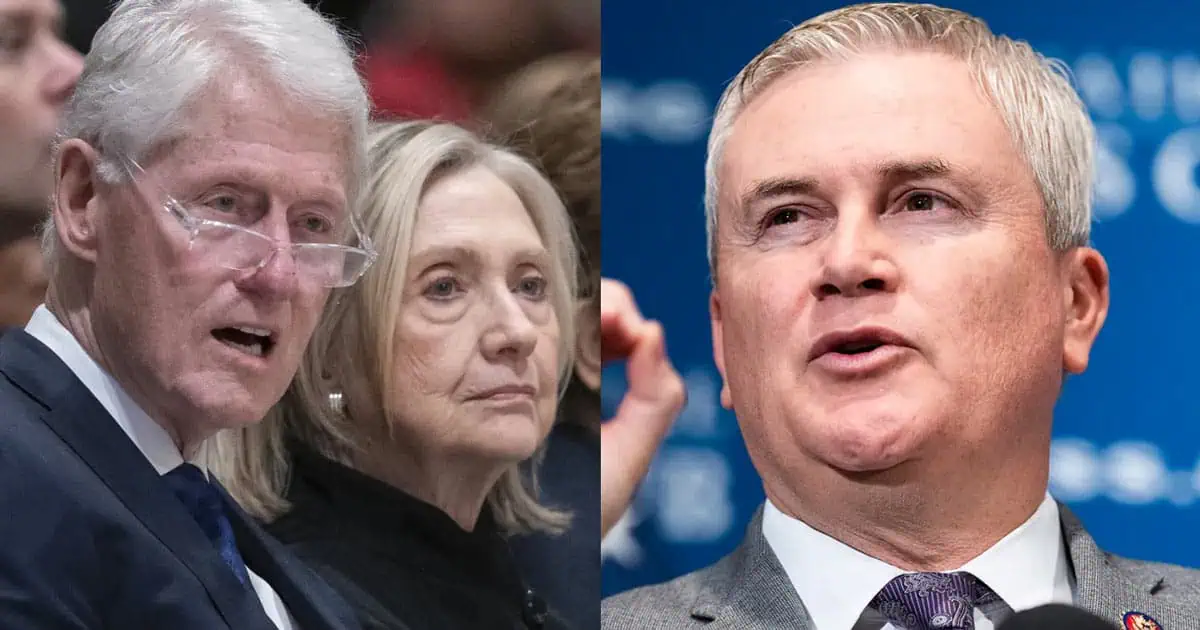
Former President Bill Clinton and former Secretary of State Hillary Clinton are now objecting to their private depositions before the House Oversight Committee being recorded on video, appearances they previously agreed to as part of the committee’s investigation into Jeffrey Epstein.
The dispute threatens to derail the Clintons’ scheduled Feb. 26 and Feb. 27 depositions.
The Clintons eventually caved and agreed to testify, a move that had halted a potential House floor vote to hold them in criminal contempt of Congress after months of negotiations between their legal team and congressional investigators.
Bill Clinton publicly framed the process as partisan in a Friday statement.
“Chairman Comer says he wants cameras, but only behind closed doors, Clinton said.
“It serves only partisan interests.
“This is not fact-finding, it’s pure politics.”
He added:
“I will not sit idly as they use me as a prop in a closed-door kangaroo court.”
The objections come despite the Clintons’ prior agreement to sit for sworn questioning under negotiated terms.
Chairman James Comer Pushes Back
House Oversight Committee Chairman James Comer (R-KY) responded by pointing to correspondence showing videotaping procedures were discussed throughout negotiations with the Clintons’ attorneys.
Recording depositions, Comer noted, is standard congressional practice.
“The Clintons are now pushing a false narrative to play victim,” Comer said.
Comer also emphasized that public hearings remain possible, but only after the Clintons complete the depositions they already committed to.
“The Clintons can have their hearing after completing the depositions they agreed to,” he added.
The distinction is significant.
Depositions involve extended questioning under oath.
Public hearings, meanwhile, are structured around timed statements and limited exchanges, formats that shape how testimony reaches the public.
Maxwell’s Fifth Amendment Move Raises Stakes
As the Clintons resist videotaped questioning, convicted Epstein associate Ghislaine Maxwell was scheduled for a virtual deposition before the same committee.
During the deposition, Maxwell invoked her Fifth Amendment right against self-incrimination.
The committee is examining the Clintons’ relationship with Epstein.
Meanwhile, public reporting has drawn attention to Maxwell’s involvement in helping establish funding structures connected to the Clinton Global Initiative.
Unlike Maxwell, the Clintons have not indicated that they will be invoking constitutional protections.
Their objection centers specifically on videotaping conditions tied to depositions their attorneys helped negotiate.
Contempt Threat Could Reemerge
If the Clintons refuse to appear under the agreed terms, the possibility of criminal contempt proceedings could return, this time after a negotiated agreement already prevented such a vote.
The timeline is clear: months of legal negotiations produced a deal, the deal paused contempt proceedings, and videotaping procedures were addressed during those talks.
Now, with deposition dates approaching, the Clintons are challenging the very conditions they previously accepted.
The House Oversight Committee’s investigation continues to probe connections surrounding Epstein, Maxwell, and financial networks tied to the Clintons’ philanthropic operations, lines of inquiry the former president is now publicly resisting in procedural terms.
With deposition dates looming and constitutional silence from Maxwell on one side, the standoff over cameras may determine whether sworn testimony proceeds, or whether Congress moves back toward contempt.

Our comment section is restricted to members of the Slay News community only.
To join, create a free account HERE.
If you are already a member, log in HERE.