
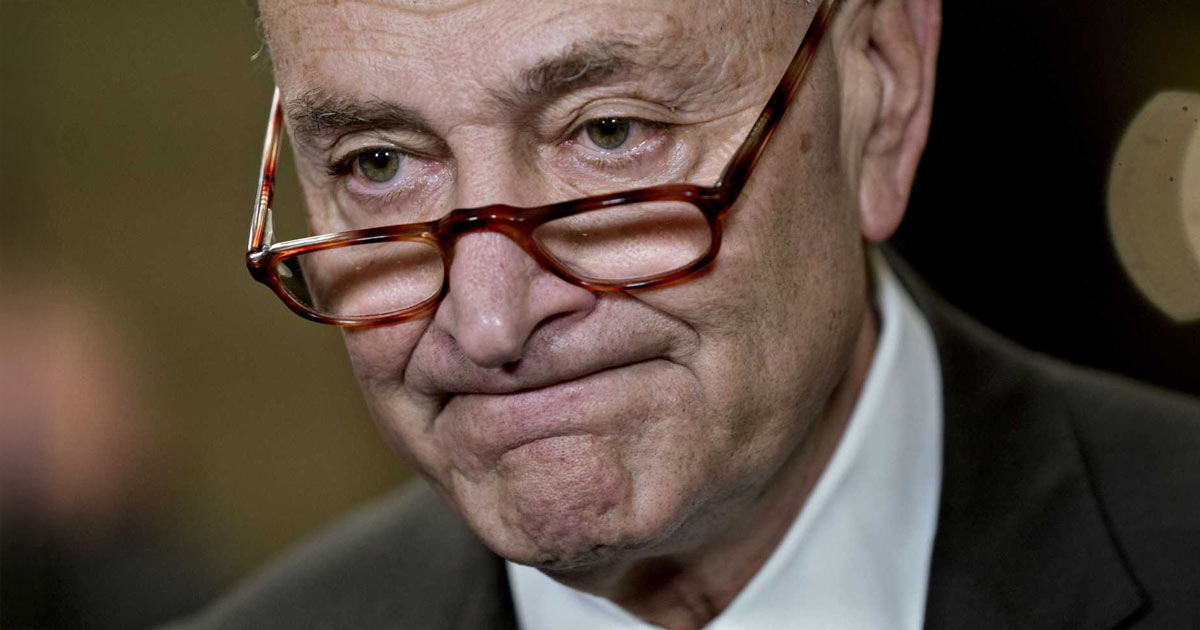
After 36 days of Senate Minority Leader Chuck Schumer’s (D-NY) historic federal government shutdown, Democrats are quietly scrambling to find a way out.
It comes as divisions within the Democrat ranks and a growing backlash from unpaid workers are complicating any move to end the standoff.
The shutdown, which entered record-breaking territory Tuesday night, has now surpassed the 2019 mark to become the longest in U.S. history.
Despite public frustration and mounting economic fallout, Democrats have continued to block Republican efforts to reopen the government.
Inside the Senate, Democratic Party leaders huddled behind closed doors for nearly three hours.
During the meeting, Democrats were debating possible off-ramps, including a vote on Obamacare subsidies and attaching spending bills to an extended continuing resolution (CR) that could run into December or January.
“It’s still a work in progress,” said Sen. Gary Peters (D-MI) after the meeting.
Sen. Schumer, who has led his caucus in refusing to back any government funding without guarantees on expiring Obamacare premium subsidies, told reporters afterward that Democrats were “exploring all the options.”
Democrats Weigh Retreat After Weeks of Political Deadlock
If Senate Democrats agree to the Republican proposal to reopen the government, it would mark a major concession after weeks of insisting on an “ironclad deal” to extend the subsidies.
“The reason we’re in this position is that we have not passed appropriations bills,” said Sen. Katie Britt (R-AL), one of several Senate appropriators pushing bipartisan talks.
“So beginning to break the logjam through doing that, we think, would be incredibly effective.”
Republicans, led by Senate Majority Leader John Thune (R-SD), have repeatedly offered to reopen the government and guarantee Democrats a vote on their healthcare bill.
However, Democrats remain skeptical.
“It’s a universe that I think is pretty well-defined and established,” Thune said.
“I’ve said this before, but the question is whether or not we’ll take ‘yes’ for an answer.”
Democrats have demanded that the vote be decided by a simple 50-vote majority, something Republicans have rejected.
“I’m interested in negotiation, but a negotiation that ends up — that ends in a piece of legislation being passed,” said Sen. Chris Murphy (D-CT).
“An agreement to take a vote that Republicans are guaranteeing will fail doesn’t sound like an outcome that helps regular Americans.”
Pressure Mounts as Shutdown Hits Working Families
While both parties have publicly expressed optimism that the shutdown could end soon, internal rifts within the Democrat caucus are growing.
Progressives, led by Sen. Bernie Sanders (I-VT), have warned Schumer not to back down.
The Left’s refusal to end the shutdown comes even as federal workers go without paychecks, air traffic controllers work without compensation, and food stamp recipients face uncertainty.
“If the Democrats cave on this, I think it will be a betrayal to millions and millions of working families who want them to stand up and protect their healthcare benefits,” Sanders said.
The White House has faced increasing criticism for failing to fund federal food benefits, despite a court order requiring partial payments under contingency funds.
Republicans have argued that Democrats’ rigid position has prolonged the crisis unnecessarily, with Thune and others pointing out that the GOP has already offered a series of pathways to reopen the government while continuing healthcare negotiations.
“[Thune] has said from Day 1 that he would provide them with a vote,” said Sen. Mike Rounds (R-SD), who has been involved in bipartisan talks throughout the shutdown.
“What he can’t do is provide them with an outcome.”
Rounds added that he believes momentum is shifting and that some Democrats are ready to move on.
“I think they’re tired of this,” he said.
A Political Standoff With Real Consequences
As the shutdown grinds on, tens of thousands of federal workers, veterans, and low-income families are feeling the impact.
Analysts warn that each additional week without a deal compounds the financial damage, not just to the government, but to American households caught in the middle.
Democrats’ strategy to hold out for Obamacare subsidies has begun to backfire politically, as even some left-leaning unions urge the Senate to accept the Republican continuing resolution and reopen the government before the next payroll deadline.
The political cost is growing, and so is the pressure.
What began as a fight over health care subsidies has become a test of leadership, endurance, and political accountability on Capitol Hill.

Our comment section is restricted to members of the Slay News community only.
To join, create a free account HERE.
If you are already a member, log in HERE.