
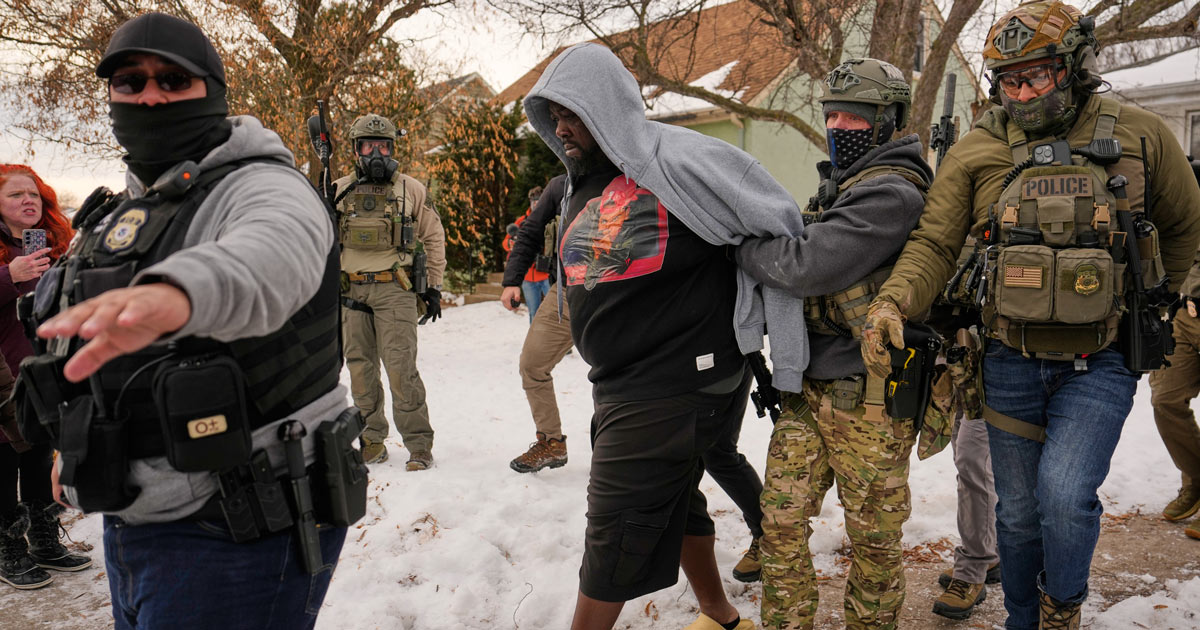
The U.S. Department of Homeland Security (DHS) has announced the results of a major crackdown in Minnesota, arresting hundreds considered to be the “worst of the worst” illegal aliens with criminal records.
Breitbart reported that the DHS announced arrests in Minnesota as part of Operation Metro Surge, a targeted effort to remove dangerous criminal migrants from local communities.
The operation included individuals convicted of serious offenses such as sexual abuse of a minor, aggravated sexual assault, domestic assault, and narcotics possession for sale.
The day prior, DHS also disclosed additional arrests in the state, focusing on similar public safety threats.
Those detained include individuals from various countries, with convictions ranging from violent assaults to drug trafficking and sexual crimes.
Specific cases highlighted by DHS feature Ger Vang from Laos, convicted of sexual abuse of a minor, and Flavio Rodrigo-Panza from Ecuador, convicted of aggravated sexual assault.
Other notable arrests involve charges like domestic assault and driving under the influence.
The issue has sparked significant debate over immigration enforcement and community safety.
While DHS frames Operation Metro Surge as a necessary step to protect Minnesotans, the operation raises questions about state and federal cooperation on immigration policy.
Assistant Secretary Tricia McLaughlin didn’t hold back, stating:
“Just yesterday, DHS arrested multiple sex offenders, violent assailants, and drug traffickers in Minnesota.”
That’s a stark reminder of the stakes involved.
However, it leaves many asking why these individuals were still walking free in communities before federal intervention.
The list of those detained reads like a catalog of serious threats.
Take Thao Pao Xiong from Laos, with convictions spanning domestic abuse to possession of a short-barreled shotgun.
Or consider Luis Amigon-Dominguez from Mexico, convicted of assault with a dangerous weapon.
These aren’t minor infractions and raise major red flags for public safety.
DHS is putting the pressure on Minnesota officials to step up.
McLaughlin made it clear, saying:
“We are calling on Minnesota politicians to allow us into their jails to arrest criminal illegal aliens instead of releasing them back into American communities to commit more crimes and create more victims.”
That’s a direct challenge to state policies that often prioritize sanctuary over security.
It raises serious concerns about why dangerous criminals are being protected by state officials.
If over 1,360 illegal aliens with criminal records are in state custody, as DHS notes, why isn’t there a streamlined process to honor federal detainers?
It’s hard to justify releasing individuals with violent histories back into American communities.
It comes as DHS officers are risking their lives to apprehend these threats, yet they face roadblocks from local authorities.
That disconnect between state and federal priorities is a glaring problem.
Look at cases like Roberto De Leon-Garcia from Mexico, arrested for second-degree criminal sexual conduct involving a minor.
Or Javier Alexander Ramirez-Llumiquinga from Ecuador, with multiple DWIs and another pending.
These aren’t isolated incidents, and they point to systemic gaps in enforcement.
Operation Metro Surge is a wake-up call.
While some may argue for leniency or sanctuary policies, the reality of violent crime can’t be ignored.
Protecting communities means addressing threats head-on, not looking the other way.
Minnesota’s reluctance to fully cooperate with federal immigration enforcement isn’t new.
But when DHS highlights specific individuals with extensive rap sheets, like Philip Adjoko from Ghana, convicted of assault with a dangerous weapon, it’s tough to argue against tighter coordination.
The broader immigration debate often gets lost in ideology, but this operation brings it back to brass tacks.
Public safety isn’t negotiable, and DHS is making a case that state-level resistance undermines that goal.
Still, any solution must prioritize community well-being.
Operation Metro Surge isn’t the end of this story, however.
It’s a flashpoint in a much larger struggle over how to handle unauthorized migrants with criminal convictions.
The question remains: will Minnesota budge, or will this tension persist?
READ MORE – Somali Government Admits Seizing U.S-Funded Food Aid After Trump Drops Hammer

Our comment section is restricted to members of the Slay News community only.
To join, create a free account HERE.
If you are already a member, log in HERE.