
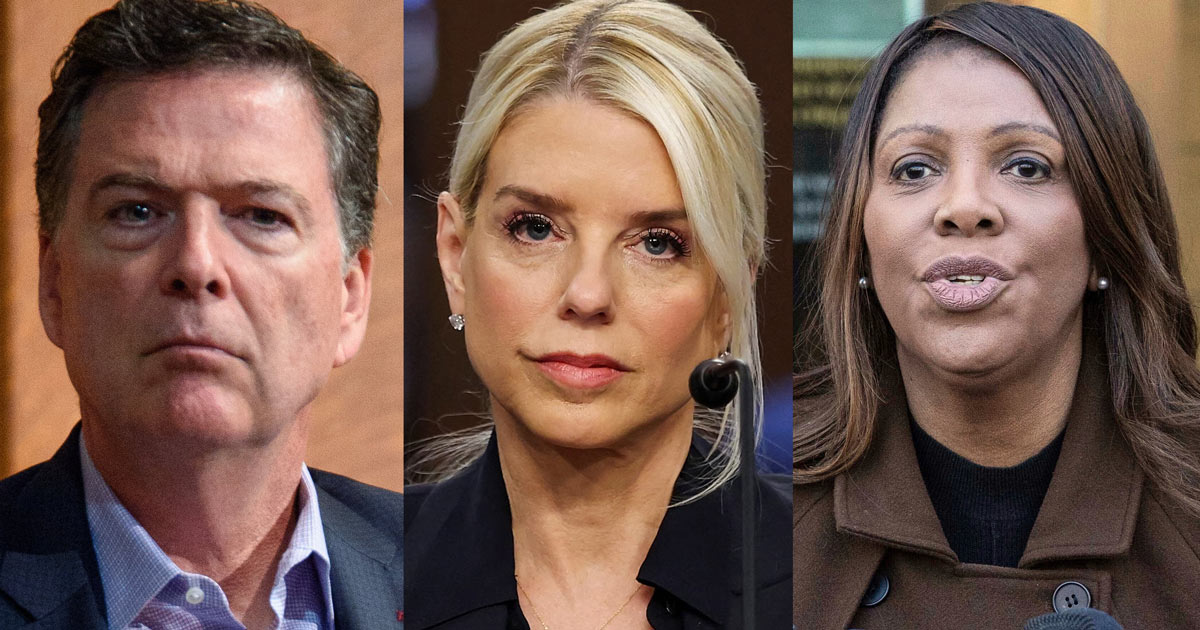
The Department of Justice (DOJ) has moved to revive criminal cases against former FBI Director James Comey and New York Attorney General Letitia James.
The DOJ has filed notices of appeal after a federal judge threw out both indictments on procedural grounds.
The appeals, submitted to the U.S. Court of Appeals for the Fourth Circuit, challenge a November ruling that dismissed the indictments without prejudice and held that the prosecutor who secured them, interim U.S. Attorney Lindsey Halligan, was unlawfully appointed.
Indictments Against Comey and James Collapsed
A federal grand jury in the Eastern District of Virginia indicted Comey in September on two counts: making a false statement to Congress (18 U.S.C. § 1001) and obstructing a congressional proceeding (18 U.S.C. § 1505).
The charges stemmed from his September 2020 Senate testimony regarding the FBI’s discredited Russia investigation, in which prosecutors alleged he misled lawmakers about leaks and the handling of sensitive materials.
The following month, the same grand jury indicted New York Attorney General Letitia James on two counts of bank fraud (18 U.S.C. § 1344) and making false statements to a financial institution (18 U.S.C. § 1014).
The allegations centered on her 2020 purchase of property in Norfolk, Virginia, which prosecutors said she improperly claimed was a secondary residence to secure favorable mortgage terms.
Both indictments were obtained by Halligan, a former White House aide and attorney for President Trump, who was appointed interim U.S. attorney in September by Attorney General Pam Bondi after her predecessor, Erik Siebert, departed amid internal friction over pursuing the cases.
Judge Rules Prosecutor’s Appointment Invalid
In November, U.S. District Judge Cameron McGowan Currie, sitting by designation, dismissed both indictments, holding that Halligan’s appointment violated federal statute (28 U.S.C. § 546) and the Constitution’s Appointments Clause.
Under § 546, the attorney general’s authority to appoint an interim U.S. attorney expires after 120 days.
Currie ruled that the 120-day window had expired following Siebert’s initial appointment, rendering Halligan’s appointment unlawful.
Because Halligan was the sole prosecutor to present evidence to the grand juries and sign the indictments, the court found the proceedings invalid.
Comey’s case faced an additional hurdle: limits on access to certain evidence and the expiration of the five-year statute of limitations for the underlying offenses.
Without reinstating the dismissed indictment, prosecutors will have no remaining path to bring charges.
Grand Juries Declined to Re-Indict James
After the dismissals, DOJ sought fresh indictments against James earlier this month.
Federal prosecutors presented the case twice to new grand juries.
Both declined to return charges, effectively shutting down the government’s attempt to relaunch the prosecution.
The Comey case could not be re-presented due to the statute of limitations barrier.
DOJ Appeals, Seeking to Revive Cases
The DOJ’s appeal asks the Fourth Circuit to overturn Currie’s ruling and restore both indictments, arguing that Halligan’s appointment was legally permissible and that the dismissals improperly nullified grand jury decisions.
The appeal is likely the final opportunity for prosecutors to pursue charges against Comey, given the statute of limitations constraints.
If the Fourth Circuit declines to reinstate the original indictment, the case will be effectively closed.
The Letitia James prosecution, although still legally viable, remains stalled after two grand juries refused to indict.
READ MORE – James Comey Mocks Trump Admin ‘Fools’ After Democrat Judge Tosses His Case

Our comment section is restricted to members of the Slay News community only.
To join, create a free account HERE.
If you are already a member, log in HERE.