
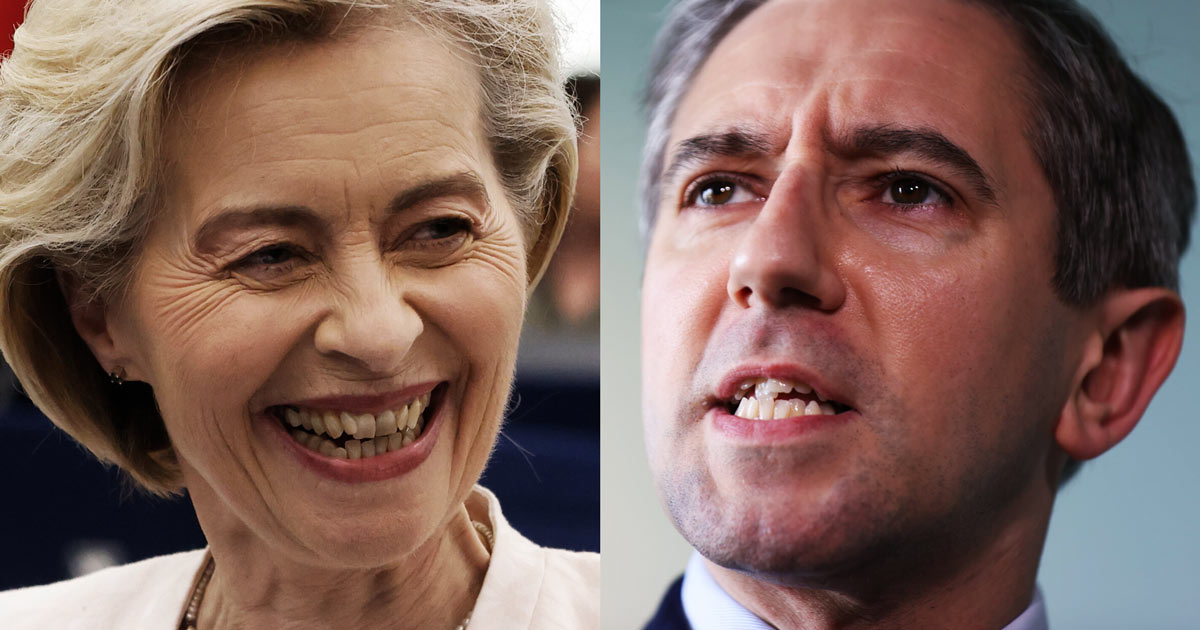
Ireland’s incoming leadership role in the European Union is being positioned to advance a sweeping new digital control agenda to end online anonymity and roll out verified identity requirements across social media platforms.
Irish Tánaiste Simon Harris confirmed that Ireland’s government intends to use its EU presidency to push for bloc-wide rules forcing users to confirm who they are before posting or interacting online.
However, critics warn that the would fundamentally transform the internet into a monitored identity-tracking grid.
Speaking to the Irish outlet Extra.ie, Harris framed the proposal as an effort to defend what he called “democracy” from online anonymity and what he described as digital manipulation.
The push will advance in parallel with an upcoming policy from Media Minister Patrick O’Donovan aimed at preventing children from accessing social media.
It’s a plan modeled on Australia’s restrictions and expected to roll out during Ireland’s EU term next year.
To implement the measures, governments would need to rewrite sections of the EU’s already-controversial Digital Services Act, shifting it from platform regulation into a gateway for government-linked identity enforcement across the internet.
Privacy and free speech advocates warn that such a framework would open the door to unprecedented monitoring, blacklisting, and political enforcement against citizens who step outside approved narratives.
Harris insisted the initiative is not driven by personal grievance, but by what he described as concern for public life.
He also signaled confidence that Ireland will not be acting alone.
Pointing to growing alignment among Western leaders, Harris said:
“If you look at the comments of Emmanuel Macron…of Keir Starmer…recently, in terms of being open to considering what Australia have done…
“You know this is a global conversation Ireland will and should be a part of.”
Harris is suggesting a coordinated international movement toward identity-verified speech.
Ireland is home to many of the world’s largest technology firms.
Those companies are already under heavy EU scrutiny, and further regulation is expected to face resistance.
The United States has also increasingly pushed back against European online speech controls, even imposing visa bans on EU officials involved in such regulatory regimes.
Despite that mounting tension, Harris signaled the government plans to move forward while avoiding open confrontation, saying:
“This is a conversation we want to have now.
“We don’t want to have it in an adversarial way.
“Companies require certainty too, right?”
Harris also backed O’Donovan’s age-verification initiative, arguing that restrictions already exist in law but are not enforced.
“We have a digital age of consent in Ireland, which is 16, but it’s simply not being enforced,” he said.
From a civil liberties standpoint, critics warn that eliminating online anonymity would mark one of the most consequential shifts in Western digital policy in modern history.
Anonymous speech has long protected whistleblowers, dissidents, political critics, and citizens speaking under social, cultural, or institutional pressure.
Once identity-tracking systems are embedded into digital infrastructure, they are rarely rolled back and can easily be expanded into speech-scoring, access controls, or political surveillance.
Even Harris appeared to signal that tech platforms could be pushed to implement such measures voluntarily, without legislation, stating:
“These companies are technology companies.
“They have the ability to do more, without the need for laws.”
Harris is suggesting that platforms could deploy internal mechanisms to manage bots, algorithms, and age verification.
Opponents argue that such “voluntary compliance” would in practice amount to government-directed censorship conducted through private platforms, beyond the reach of democratic accountability.
As Ireland prepares to assume its EU leadership role, the country now stands at the center of a rapidly escalating global debate over whether the future of the internet will remain free, open, and anonymous or be transformed into a tightly controlled system where every word is tied to a verified identity and monitored from above.

Our comment section is restricted to members of the Slay News community only.
To join, create a free account HERE.
If you are already a member, log in HERE.