
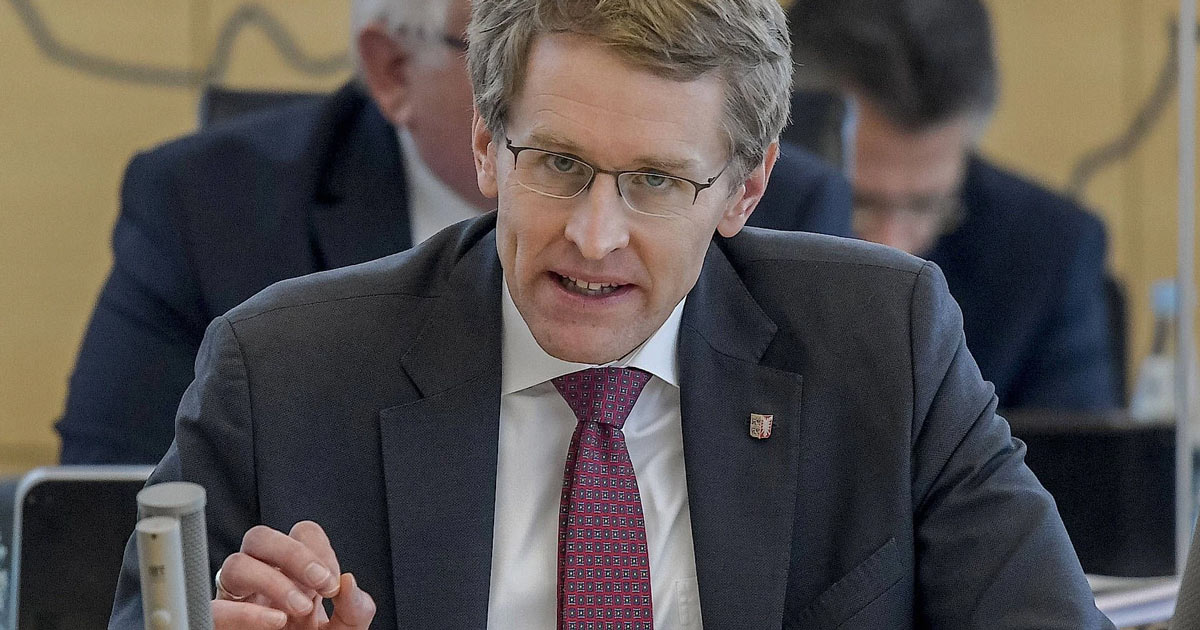
Germany’s ruling class is facing a fresh free-speech backlash after Daniel Günther, the CDU premier of Schleswig-Holstein, openly called for state regulation, censorship, and possible bans targeting media outlets and social networks he labeled “opponents and enemies of democracy.”
In a German TV appearance, Günther warned that unless the state and civil society take harsher action against what he described as online “excesses,” democracy itself would not survive the next decade.
When asked directly whether his proposal involved regulation, censorship, or outright bans, Günther did not hedge.
“Yes,” he replied. “That’s what we’re talking about.”
Calls for Age Bans and Mandatory ID
Günther went further, proposing that anyone under 16 be barred from social media entirely, a policy that would require universal age verification for all users, effectively ending anonymous speech online.
He argued the German state should cooperate directly with major tech companies, pointing to Australia as a model, to protect minors from “disinformation” and sexual exploitation.
The comments immediately reignited Germany’s long-running battle over how far the government can go in policing speech and whether dissenting opinions are being redefined as threats.
Legal Scholars Sound the Alarm
The backlash was swift.
Constitutional law professor Volker Boehme-Neßler said he was stunned by the remarks.
“I am shocked at how little understanding and how little feeling for freedom of expression a German prime minister has,” he said, reminding the public that freedom of speech explicitly includes the right to say things others consider wrong or foolish.
“You are allowed to say nonsense,” he emphasized.
“That is part of freedom of opinion and media.”
Dissent Inside the CDU, Silence at the Top
Even within Günther’s own party, the Christian Democratic Union (CDU), cracks appeared.
CDU regional chairman Jan Jacobi wrote on X that he was “appalled” by a CDU prime minister “fantasizing about which opinions should still be permitted.”
At the same time, party leadership stayed conspicuously quiet.
CDU leader Friedrich Merz and general secretary Carsten Linnemann declined to comment.
Others backed Günther outright.
Former CDU general secretary Ruprecht Polenz declared the premier “completely right.”
Opposition Calls It Authoritarian
Outside the CDU, the response was blistering.
Free Democratic Party deputy leader Wolfgang Kubicki condemned the proposal as “absolutely unacceptable authoritarian ramblings” and warned Günther to keep his “hands off press freedom.”
AfD co-leader Alice Weidel called the plan “authoritarian madness,” adding:
“Whoever abolishes freedom of opinion is themselves an enemy of the constitution.”
A Pattern Is Emerging
Günther’s comments are not happening in isolation.
Germany’s government has increasingly partnered with major platforms to police “disinformation,” while expanding speech laws that critics say blur the line between law enforcement and opinion control.
A federal court recently overturned the government’s attempt to ban the conservative magazine Compact, citing constitutional protections for free expression.
Meanwhile, journalist David Bendels continues to face prosecution over a satirical meme mocking then-interior minister Nancy Faeser.
The common thread: dissenting voices are increasingly treated not as participants in debate, but as problems to be managed.
Speech as the New “Threat”
Rather than counter ideas with arguments, political leaders are turning to regulatory power, administrative bans, and corporate content policing.
Günther’s remarks crystallize that shift, the belief that speech itself, not violence or crime, must be controlled by the state for democracy to survive.
Germany’s constitution guarantees broad protection for freedom of opinion and the press.
Whether that guarantee still holds, or is quietly being hollowed out in the name of “safety” and “democracy,” is now an open question.
What happens next may reveal whether Germany still believes that open debate is the foundation of democracy, or whether only state-approved speech is allowed to remain.

Our comment section is restricted to members of the Slay News community only.
To join, create a free account HERE.
If you are already a member, log in HERE.