
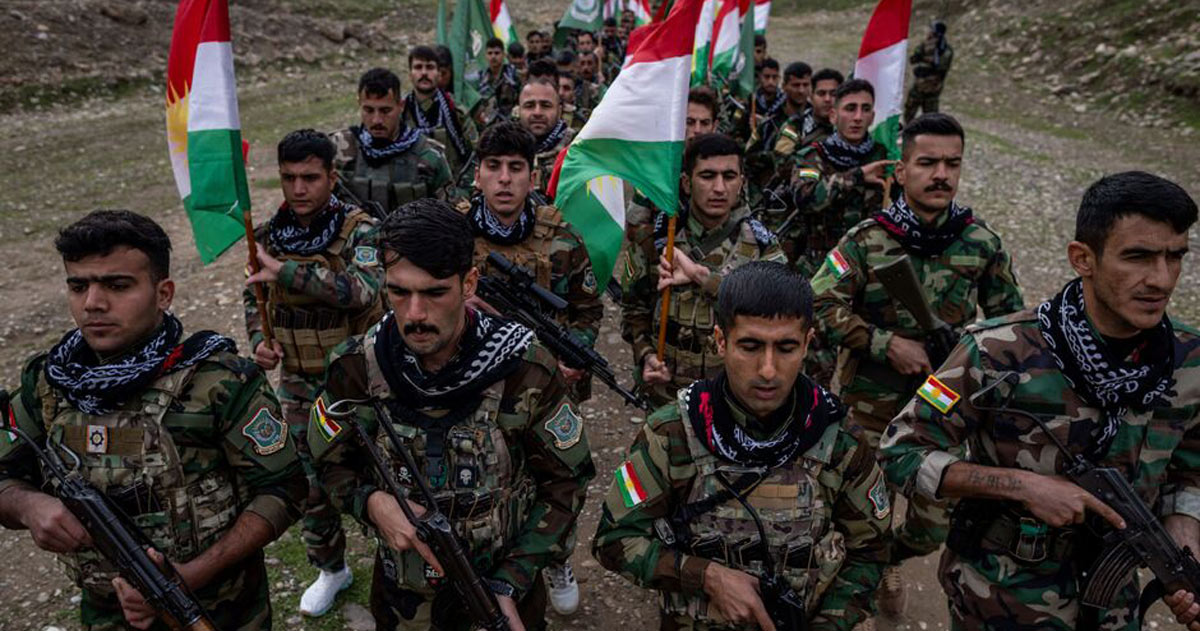
Kurdish Iranian dissident groups based in northern Iraq say they are positioning fighters near the Iranian border and preparing for possible military operations inside Iran.
Officials from the groups told The Associated Press that thousands of trained fighters could potentially be mobilized, and that Kurdish forces are now on standby as the regional conflict intensifies following the recent U.S. and Israeli strikes on Iran.
Kurdish Fighters Positioned Near the Border
Khalil Nadiri, an official with the Kurdistan Freedom Party (PAK), said some of the group’s fighters have already moved closer to the Iranian border in Sulaymaniyah province.
According to Nadiri, those units are now waiting for further developments.
An official with Komala, another Iranian Kurdish opposition organization, said its fighters could be ready to cross into Iran within seven to ten days if conditions permit.
Together, the two groups are believed to have several thousand trained fighters.
Report: Trump Spoke with Kurdish Leaders
Three Kurdish officials told the AP that President Donald Trump held a phone call Sunday night with two major political leaders in Iraqi Kurdistan:
- Masoud Barzani, head of the Kurdistan Democratic Party
- Bafel Talabani, leader of the Patriotic Union of Kurdistan (PUK)
One Kurdish official said Trump asked Iraqi Kurdish authorities to support Iranian Kurdish opposition groups militarily and to allow access across the border.
The Patriotic Union of Kurdistan confirmed that the call took place.
In a statement, the PUK said Trump “provided clarification and vision regarding U.S. objectives in the war.”
The group also added that it “believes that the best solution is a return to the negotiating table.”
Representatives for Barzani declined to comment.
White House Stops Short of Confirming Military Plan
White House Press Secretary Karoline Leavitt acknowledged that President Trump spoke with Kurdish leaders but described the conversation more narrowly.
“He did speak to Kurdish leaders with respect to our base that we have in northern Iraq,” Leavitt said when asked about the call.
She denied that the administration had agreed to a specific military plan involving Kurdish forces.
Secretary of War Pete Hegseth also declined to confirm any effort to arm Kurdish fighters.
“None of our objectives are premised on the support or the arming of any particular force,” Hegseth said.
“So, what other entities may be doing, we’re aware of, but our objectives aren’t centered on that.”
Iran Pressures Iraq to Prevent Cross-Border Operations
Iran has already expressed concern about Kurdish opposition activity along its western border.
Iraq’s National Security Adviser Qassim al-Araji said Iranian officials requested action to stop Kurdish fighters from entering Iranian territory.
Ali Bagheri, deputy secretary of Iran’s Supreme National Security Council, asked Iraq to ensure “that Iraq takes the necessary measures to prevent any opposition groups from infiltrating the border between the two countries,” according to al-Araji.
Al-Araji said Baghdad would work to stop armed groups from launching operations from Iraqi territory.
He added that additional security forces have been deployed to the border region.
Kurdish Opposition to Iran Has Long History
Kurdish resistance to Iran’s ruling regime dates back decades.
Following the 1979 Islamic Revolution, Kurdish insurgents fought Iranian government forces in a conflict that left thousands dead.
Even before the revolution, Kurdish communities in Iran frequently clashed with authorities under the Shah’s government, citing political repression and discrimination.
In 2023, Iraq reached an agreement with Iran requiring Kurdish opposition groups to disarm and relocate from border bases into camps designated by the Iraqi government.
Those bases were dismantled, and movement was restricted.
However, the groups did not surrender all of their weapons, a fact that now carries new significance as tensions rise in the region.
Iran Faces Pressure on Multiple Fronts
The mobilization of Kurdish fighters comes as Iran is already under significant military pressure.
U.S. and Israeli forces launched coordinated strikes against Iranian targets under Operation Epic Fury, while drone and missile attacks have been reported across the region.
Recent strikes have targeted:
- U.S. military bases in Iraq
- The U.S. Consulate in Irbil
- Kurdish opposition positions
Iranian-backed militias have also been blamed for several attacks.
The Kurdish region has experienced electricity outages after a major gas field halted operations following missile strikes.
Potential Strategic Impact
If Kurdish fighters cross the border, Iran could face a new front in the conflict.
That scenario would place pressure on Tehran from both external military operations and internal opposition forces.
The PUK emphasized that diplomacy remains the preferred outcome.
However, the group acknowledged that the region’s rapidly changing situation could reshape the strategic landscape.
For now, Kurdish fighters remain positioned near the border, waiting to see how the conflict unfolds.

Our comment section is restricted to members of the Slay News community only.
To join, create a free account HERE.
If you are already a member, log in HERE.