
Major U.S. and European automakers are sharply scaling back electric vehicle (EV) ambitions as consumer demand collapses, reversing once-aggressive roadmaps toward full electrification.
The latest company to pull the plug is Lamborghini.
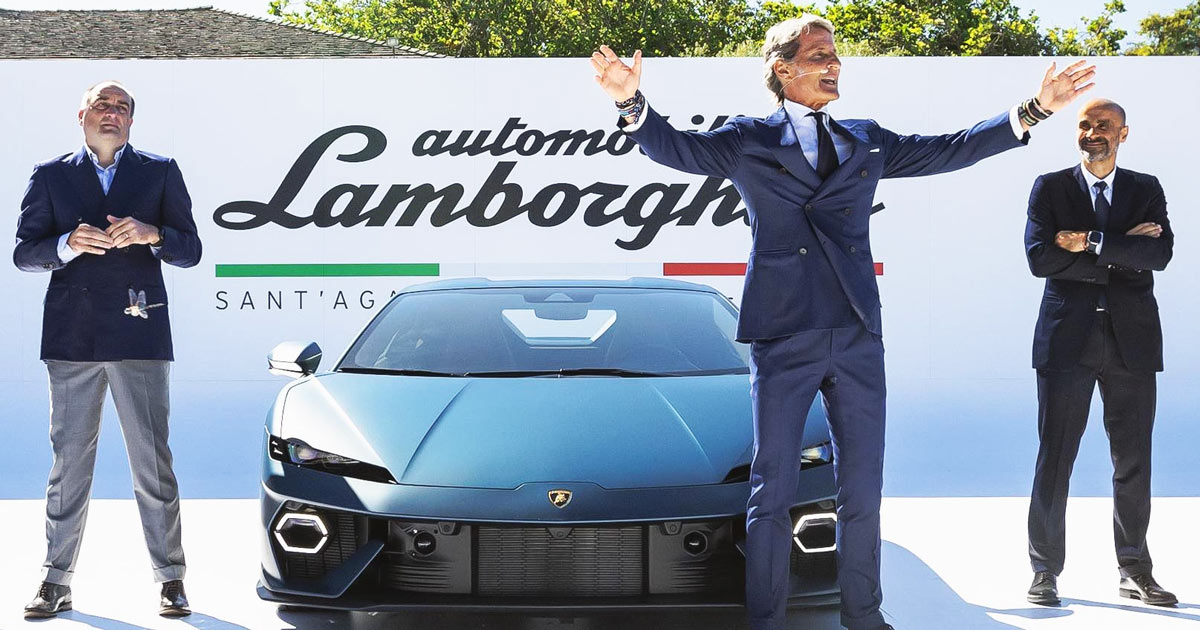
Lamborghini CEO Pulls Plug on EV Supercars
Lamborghini CEO Stephan Winkelmann told the UK’s The Sunday Times that the company has ended plans to build fully electric vehicles.
The supercar executive cited weak demand and a lack of enthusiasm from its core customer base.
Winkelmann said EV development risked becoming “an expensive hobby” for the automaker.
He confirmed that the previously announced all-electric concept car, Lanzador, will no longer move forward as part of Lamborghini’s future lineup.
Winkelmann noted that the “acceptance curve” for EVs in Lamborghini’s market segment was flattening and “close to zero.”
Instead of moving forward with a fully electric model, the company will replace the Lanzador with a plug-in hybrid.
Winkelmann also said Lamborghini intends to continue producing gas-powered internal combustion engines “for as long as possible.”
“EVs, in their current form, struggle to deliver this specific emotional connection,” Winkelmann explained.
He added that luxury performance buyers still want the sound and feel of a traditional engine.
Broader Industry Pullback
The retreat from aggressive EV targets is not limited to high-end brands.
Over the past six months, several mass-market automakers have announced major revisions to their electrification strategies:
Ford recorded a $19.5 billion loss, canceled multiple planned EV programs, and redirected investment toward hybrids and other priorities.
General Motors announced a $6 billion charge to unwind portions of its EV investments, adjusting factories and battery plants to better align with demand.
Stellantis booked 22.2 billion euros in charges tied to scaling down EV ambitions and has reintroduced more gasoline-powered models in parts of Europe as EV sales slow.
Volkswagen Group delayed key next-generation EV initiatives, including its Trinity project, into the early 2030s, and took a significant financial hit tied to Porsche slowing parts of its EV rollout.
Porsche has postponed certain EV launches while extending combustion-engine and hybrid programs.
Mercedes-Benz revised its prior all-EV timelines and now targets up to 50% electrified vehicles, including hybrids, by 2030, a slower pace than previously projected.
Volvo Cars abandoned its 2030 EV-only target in favor of a more flexible strategy that includes hybrids.
Honda reduced planned electrification and software investment, shifted focus toward hybrids, and paused a major Canadian EV supply-chain project for roughly two years.
Aston Martin delayed its first battery-electric vehicle again, prioritizing plug-in hybrids.
Bentley indicated that hybrids will likely remain part of its lineup beyond earlier all-EV timelines.
Ferrari revised its 2030 sales mix target to 40% internal combustion engine vehicles, 40% hybrids, and 20% fully electric vehicles, cutting its previous goal of 40% EV sales in half.
Market Reality Reshapes Strategy
The shift by Western automakers reflects mounting challenges in consumer adoption, high development costs, and profitability concerns.
It comes after years of aggressive electrification pledges driven by regulatory pressure and government incentives.
However, manufacturers are now recalibrating around hybrids and combustion engines as they respond to actual market demand.
For brands like Lamborghini, performance, engine sound, and driving feel remain central to the product.
As such, executives are now making clear that full electrification, at least for now, is not what their customers are asking for.
READ MORE – Report: ‘Exotic Vehicle of Unknown Origin’ Secretly Stored at U.S Navy Base

Our comment section is restricted to members of the Slay News community only.
To join, create a free account HERE.
If you are already a member, log in HERE.