
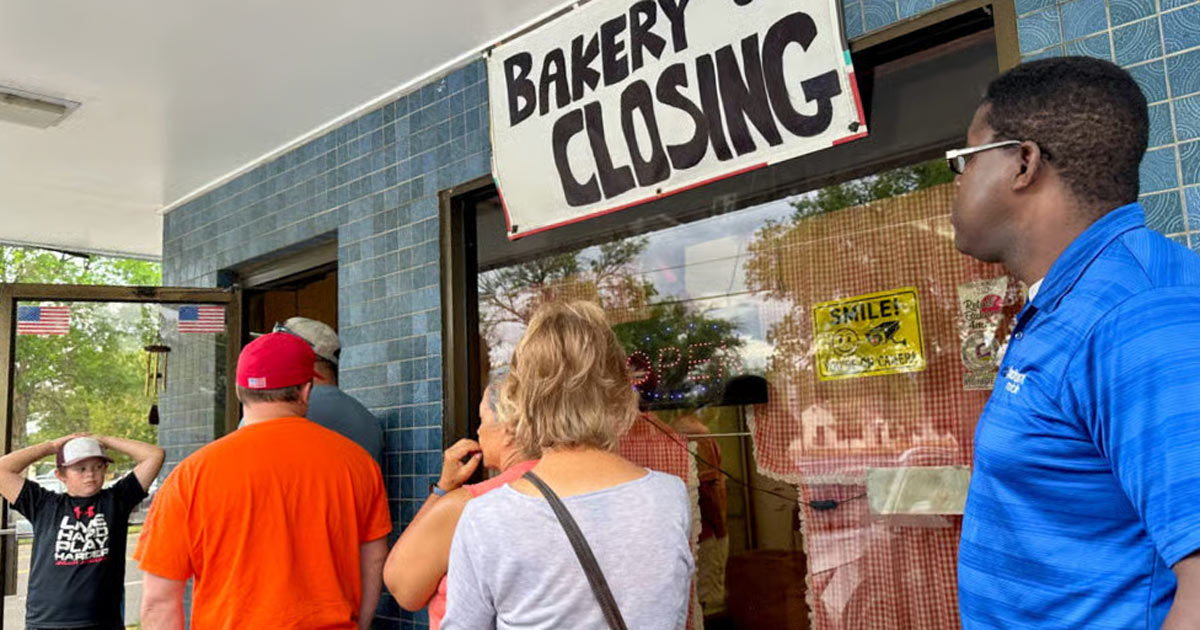
America’s independent mom-and-pop businesses are facing a rapid surge in bankruptcies as financial pressures harden into a full-scale economic crisis.
The struggles of small restaurants, hardware stores, and family-run shops that define Main Street could be an early warning sign that the economy is starting to crack.
According to a new report, the trend is not a temporary downturn but a widespread collapse affecting communities across the country.
Court data analyzed by Bloomberg shows that more than 2,200 individuals and small businesses have already filed for bankruptcy this year under a specialized federal reorganization provision created to help struggling small enterprises stay afloat.
The total marks the highest number of filings since the program was established six years ago, a stark indicator of rising financial strain.
What was once intended as a safety net has increasingly become a last resort for business owners who can no longer meet their obligations or keep their doors open.
Creditors, analysts say, are no longer extending leniency.
“We’re seeing two different economic realities on both the consumer and the business landscape,” Taylor Bowley, an economist at the Bank of America Institute, told the Wall Street Journal.
Behind the statistics, the bankruptcies are reshaping local communities.
Family restaurants that once hosted celebrations are shuttering.
Long-standing retail shops are liquidating inventory at steep discounts.
Service businesses that once sustained local employment are being dismantled as debts pile up faster than revenues can recover.
Analysts say the gap suggests stronger players are weathering the storm, while weaker chains and small operators are being quietly pushed out.
“As costs for goods go up, many small businesses can’t raise prices fast enough because customers would complain, which means they’re making less money even when sales stay steady,” Leslie Tayne, a New York-based debt resolution attorney, told the Daily Mail.
“Business owners pour their heart and soul into their business, and often have trouble stomaching financial turmoil arising.”
Economists note that several economic forces have converged to drive the crisis: sustained high interest rates, tighter credit conditions, and increasingly cautious consumer spending.
Unlike large corporations, small businesses lack significant capital reserves and cannot rapidly absorb prolonged declines in cash flow.
Each passing month brings higher costs, fewer customers, and shrinking margins.
Analysts warn that the trend reflects more than individual financial hardship; it signals a broader “Main Street recession.”
When small businesses fail at scale, the economic impact ripples outward, eliminating jobs, weakening local tax bases, and accelerating the decline of commercial districts.
The fallout is being felt among employees as well.
Workers who relied on steady paychecks are now facing sudden layoffs and uncertainty.
Once-busy town centers are growing quieter, with empty storefronts emerging as visible markers of economic distress.
For many communities, the losses extend beyond economics.
The disappearance of long-standing local businesses represents the erosion of cultural anchors, places that served as gathering spots, employers, and family legacies.
The wave of bankruptcies continues to climb, and economists warn that unless financial conditions ease or consumer demand improves, more Main Street closures are likely ahead.
READ MORE – Trump Economist: American Families Should Expect ‘Massive’ Tax Savings

Our comment section is restricted to members of the Slay News community only.
To join, create a free account HERE.
If you are already a member, log in HERE.