
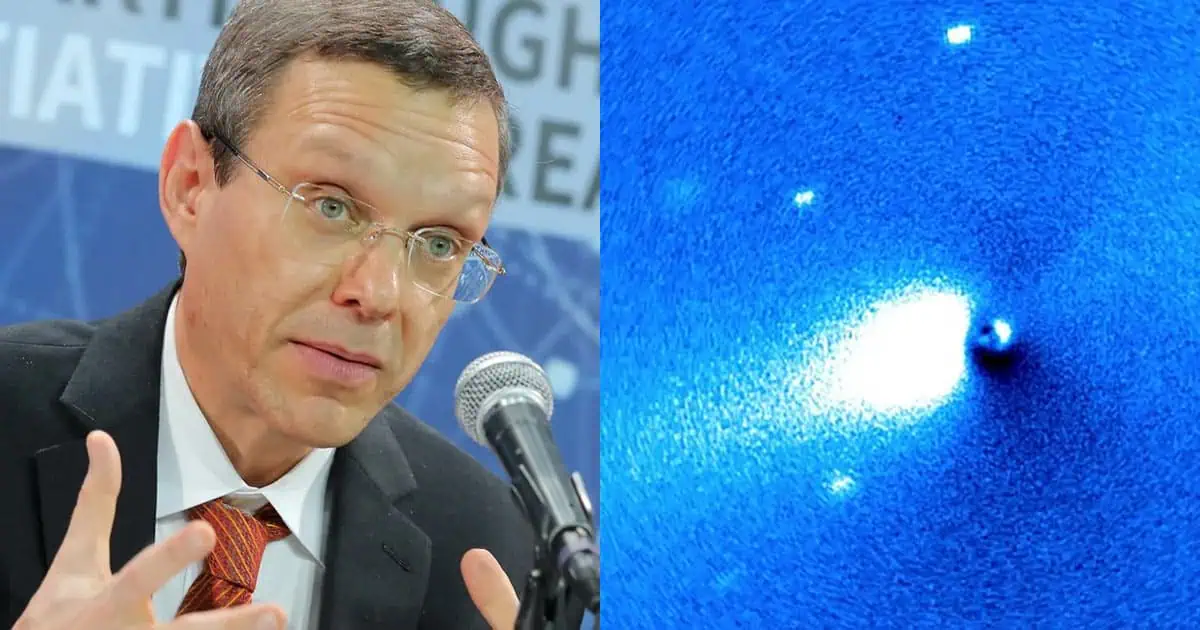
Astronomers have discovered that the mysterious interstellar visitor 3I/ATLAS is exhibiting a bizarre, rhythmic “pulsating heartbeat” as it approaches Earth, leaving scientists stunned.
3I/ATLAS is set to make its closest pass by Earth on December 19.
However, experts are now warning that the newly-discovered “heartbeat” phenomenon is so precise and powerful that it does not look like the behavior of a natural comet.
New telescope observations show that 3I/ATLAS is firing jets of gas, dust, and ice in perfect 16.16-hour intervals, causing its glow to brighten and dim by 20 to 40 percent every cycle.
The bursts are so clean and consistent that some researchers argue the object may be unnatural in origin.
Both NASA and the European Space Agency insist the object is simply a lifeless comet, dismissing any suggestion of extraterrestrial technology.
However, the data continues to raise major alarms.
A “Heartbeat” Too Powerful to Ignore
Astronomers say the object likely has a spinning core that rotates once every 16.16 hours.
As specific pockets of ice rotate toward the Sun, the heat vaporizes them, firing jets of material outward at 985 mph across distances of nearly 16,000 miles.
In theory, this creates the timed rhythmic bursts.
But critics say that the explanation falls apart when you examine the light itself.
Harvard astrophysicist Avi Loeb, who has studied unexplained interstellar objects for years, says the pulses are far too bright to match what scientists know about comet behavior.
The vast majority of light comes from the comet’s coma, a giant cloud of gas and dust stretching hundreds of thousands of miles around the object.
If the rocky core is spinning and firing jets, the coma should act like a soft blanket that would smooth out any flashes, not amplify them.
Loeb noted that under normal physics, brightness might vary up to 5 percent, not 20 to 40 percent, as telescopes actually see.
He argues that this mismatch doesn’t fit the standard comet model at all.
Loeb: The Behavior Looks “Unnatural”
The astrophysicist, who has repeatedly urged scientists not to dismiss the possibility of alien technology too quickly, suggested that 3I/ATLAS’s pulsing glow could be a sign the object isn’t naturally occurring.
He previously identified a dozen unexplained anomalies, including:
• A comet tail pointing in the wrong direction
• The object changing color and turning blue near the Sun
• Course shifts that contradict gravitational expectations
NASA dismisses these irregularities as quirks of a comet from a distant solar system with unusual chemistry.
But the agency’s answers have not satisfied everyone, especially as new data keeps challenging previous assumptions.
Pulses Detected Months Ago Are Still Strengthening
Astronomers first reported the 16.16-hour cycle in August 2025 after carefully tracking changes in brightness from ground-based telescopes.
Researchers now believe the “heartbeat” may have been active long before the object was discovered, linked to its spin and heating patterns as it traveled through the solar system.
UN and NASA Say No Threat, But Planetary Defense Teams Are Quietly Watching Closely
NASA and the United Nations (UN) insist that 3I/ATLAS poses no threat and will pass no closer than 170 million miles from Earth.
However, given its unusual behavior and its status as only the third confirmed interstellar object ever observed, global defense agencies are studying it closely.
On November 27, the UN confirmed that Earth’s planetary-defense network began monitoring 3I/ATLAS as it prepares to exit the solar system.
The International Asteroid Warning Network (IAWN) has launched a two-month observation campaign aimed at sharpening early-warning systems for future cosmic threats.
Loeb: Scientists Should Keep Their Minds Open
While mainstream scientists label 3I/ATLAS a comet, Loeb urges caution and curiosity.
As he told the Daily Mail in October:
“Here we are talking about a potential for something that could affect humanity in the future in a dramatic way, and so you shouldn’t apply the same approach of being as conservative as possible.”
With the object’s arrival just two weeks away, scientists and skeptics say this could be one of the most important cosmic encounters in modern history.

Our comment section is restricted to members of the Slay News community only.
To join, create a free account HERE.
If you are already a member, log in HERE.