
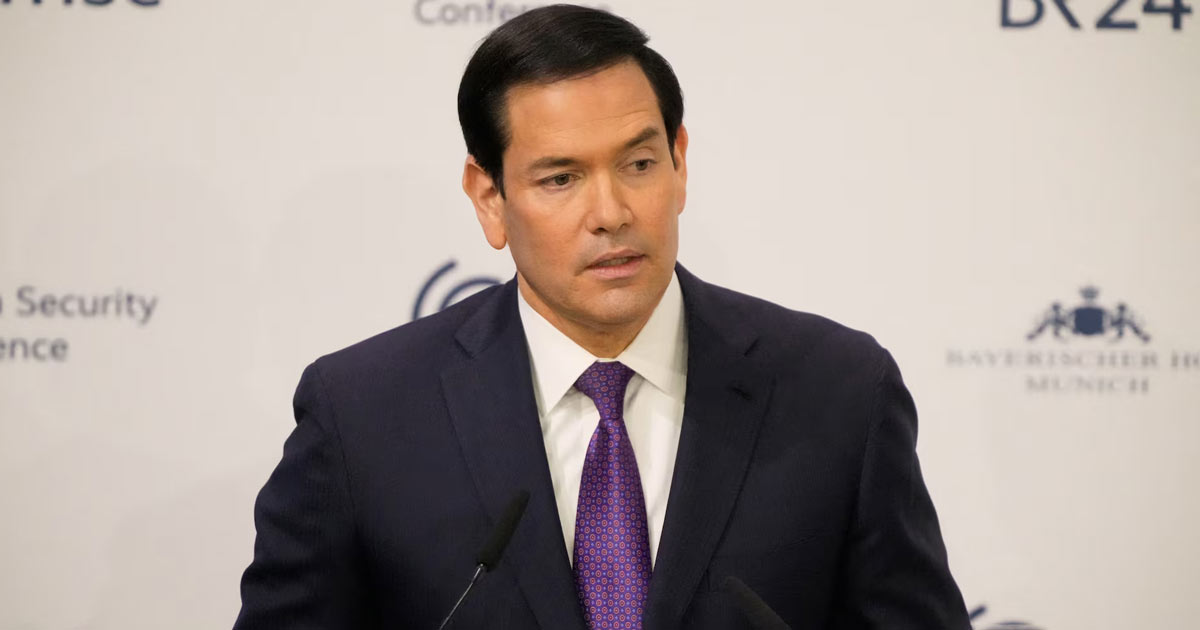
Secretary of State Marco Rubio told European leaders at the Munich Security Conference that the United States will no longer serve as a passive steward of Western decline, delivering one of the most direct transatlantic messages from an American diplomat in decades.
In a roughly 3,000-word address, Rubio called for secure borders, renewed industrial strength, restored national sovereignty, and a European alliance capable of carrying a greater share of its own defense burden.
“We in America have no interest in being polite and orderly caretakers of the West’s managed decline,” Rubio said.
The remark signaled a clear shift in tone from the traditional diplomatic language that has long defined the annual conference, where American officials have typically emphasized multilateral continuity and institutional stability.
A Break From Diplomatic Convention
Rubio framed economic erosion, weakened borders, and dependence on global institutions as interconnected challenges facing Western nations.
Rebuilding domestic industry, enforcing immigration limits, and strengthening defense capacity formed the core of his proposed response.
The address departed sharply from the consensus-driven messaging that has historically characterized U.S. participation in Munich, replacing reassurance with a call for structural renewal across the Western alliance.
Renewing, Not Abandoning, the Alliance
Rubio rejected claims that a stronger emphasis on sovereignty would signal American withdrawal from global leadership.
“We do not seek to separate, but to revitalize an old friendship and renew the greatest civilization in human history,” he said.
The Trump administration has repeatedly urged European governments to increase defense spending and reduce long-term reliance on U.S. security guarantees.
Rubio positioned those demands within a broader argument that alliances remain strongest when partners are capable of independent strength.
WATCH:
Europe Confronts Strategic Choices
Rubio’s remarks placed renewed focus on long-standing concerns about military readiness, border control, and industrial capacity across parts of Europe, issues that have shaped transatlantic debates for years.
His speech presented the alliance as a structure that must adapt to present conditions rather than rely solely on Cold War-era assumptions.
The administration’s approach treats transatlantic relations as a partnership to be rebuilt through reciprocal strength rather than maintained through inertia.
A Defining Signal of U.S. Policy Direction
The Munich address offered the clearest articulation to date of how the Trump administration views the future of Western cooperation: continued partnership grounded in sovereignty, defense capability, and economic resilience.
Rubio did not frame the moment as a rupture with Europe.
Instead, he described it as a turning point, one requiring allies prepared to meet shared challenges with renewed capacity and resolve.

Our comment section is restricted to members of the Slay News community only.
To join, create a free account HERE.
If you are already a member, log in HERE.