
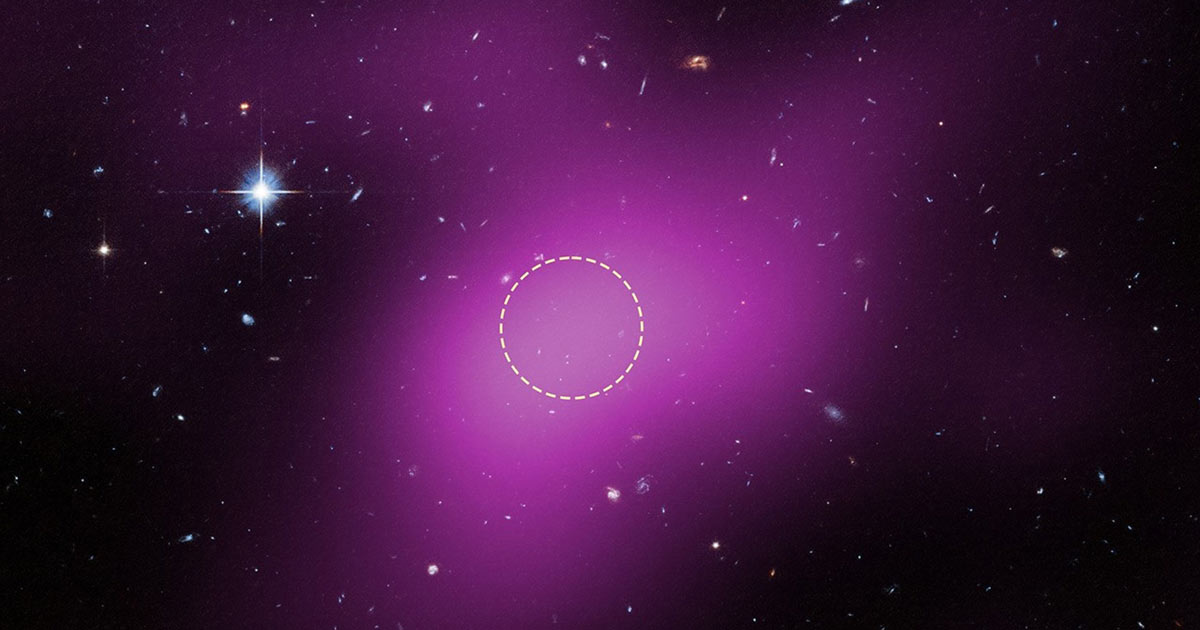
Scientists have identified a strange new type of astronomical object that researchers say may represent a missing link in galaxy formation, revealing a massive, starless cloud rich in gas and dark matter, described as a “window into the dark universe.”
The object, named Cloud-9, sits roughly 14 million light-years from Earth and consists of a dense, compact core of neutral hydrogen gas spanning about 4,900 light-years across.
It’s more than 1,000 times the distance between Earth and Proxima Centauri.
Despite containing abundant raw material for star formation, new observations from the Hubble Space Telescope confirm that Cloud-9 contains no stars at all.
Scientists say the object appears to be a “failed galaxy,” a relic structure from the early universe that never accumulated enough mass to ignite star formation.
Co-author Dr. Andrew Fox of the European Space Agency and the Space Telescope Science Institute explains:
“You can think of it as a failed galaxy.
“A ghostly object that didn’t quite have enough mass to become self-gravitating and cross the threshold into star formation.”
Cloud-9 is believed to be an example of a long-theorized structure known as a Reionization-Limited H I Cloud, or RELHIC, an object composed largely of dark matter surrounded by gas.
Although dark matter cannot be directly observed, researchers say its gravitational effects are unmistakable.
“The main piece of evidence for dark matter in this cloud is its size,” Dr. Fox explains.
“A cloud this size needs a source of gravity to hold it together.
“There are no stars to provide this gravity, and the neutral hydrogen gas does not contain enough mass, so dark matter must be the culprit.
“Without it, the cloud would simply fall apart.”
Analysis of Cloud-9 suggests the cloud contains hydrogen with a mass roughly one million times that of the Sun, but remaining stable at that scale would require an estimated five billion solar masses of dark matter.
Scientists say that this places the object just below the predicted threshold needed to trigger galaxy formation.
“Theories of galaxy formation predicted that there is a minimum threshold of dark matter required to ignite star formation and turn a dark cloud into a luminous galaxy,” Dr. Fox notes.
“With Cloud-9, we have an example of an object just below this threshold, containing no stars.”
Researchers say such objects are extremely rare.
If Cloud-9 had significantly more mass, its gas would have collapsed into stars, forming a dwarf galaxy.
Any less, and it likely would have dissipated entirely.
Co-author Dr. Alejandro Benitez Llambay of the Milano-Bicocca University in Milan adds:
“Cloud-9 is a rare ‘middle ground’ survivor.”
“According to our models, fewer than 10 per cent of halos in this mass range remain in such a pristine state, making Cloud-9 a ‘missing link’ in our understanding of how galaxies are born.”
Because RELHICs contain no stars and emit almost no light, they are extraordinarily difficult to detect.
Cloud-9 was first identified three years ago using China’s Five-hundred-meter Aperture Spherical Telescope (FAST), but Hubble observations were required to rule out the possibility that it was simply a faint dwarf galaxy.
Lead author Dr. Gagandeep Anand of the Space Telescope Science Institute explains:
“Before we used Hubble, you could argue that this is a faint dwarf galaxy that we could not see with ground-based telescopes.
“They just didn’t go deep enough in sensitivity to uncover stars.”
“In science, we usually learn more from the failures than from the successes.
“In this case, seeing no stars is what proves the theory right.
“It tells us that we have found in the local universe a primordial building block of a galaxy that hasn’t formed.”
The study, published in The Astrophysical Journal Letters, suggests there may be more such starless dark-matter clouds in the nearby universe.
China’s FAST telescope is particularly well-suited to detecting similar hydrogen clouds, and researchers say additional candidates may soon be identified.
“There absolutely should be more RELHICs out there, and we are looking for more candidates,” Dr. Fox adds.
“We need more cases to know whether Cloud-9 is an oddball with unusual properties, or alternatively, is fairly typical.”
Astronomers say discoveries like Cloud-9 could provide critical insight into dark matter, the invisible substance believed to make up roughly 85 percent of the universe’s matter and act as the gravitational “glue” that holds galaxies together.
The European Space Agency explains that while dark matter cannot be seen directly, its gravitational effects on stars and gas reveal its presence:
“Similarly, we know dark matter exists but have never observed it directly.”
Researchers say Cloud-9 may represent one of the clearest examples yet of that unseen framework, a frozen building block of a galaxy that never came to be.
READ MORE – Space Force Family Targeted with Anti-Trump Arson Attack in D.C Home

Our comment section is restricted to members of the Slay News community only.
To join, create a free account HERE.
If you are already a member, log in HERE.